

Key Takeaways
Why counter space keeps shrinking
Counter space disappears gradually. A toaster stays out because the cabinet is full. A knife block stays out because the drawer is overstuffed. A bag of onions stays out because the pantry has no clear landing zone. Each decision is reasonable on its own, but the result is a kitchen where there is no room to actually cook.
The good news is that most small kitchens have unused or poorly used storage within arm's reach. The strategies below work with the space that already exists rather than requiring new furniture, a renovation, or significant spending. If you find that storage problems keep showing up in multiple rooms, the broader habits discussed in common frugal living myths are worth reading alongside this, since buying more storage products is sometimes the habit that is making things worse, not better.
Use walls and vertical space before buying more furniture
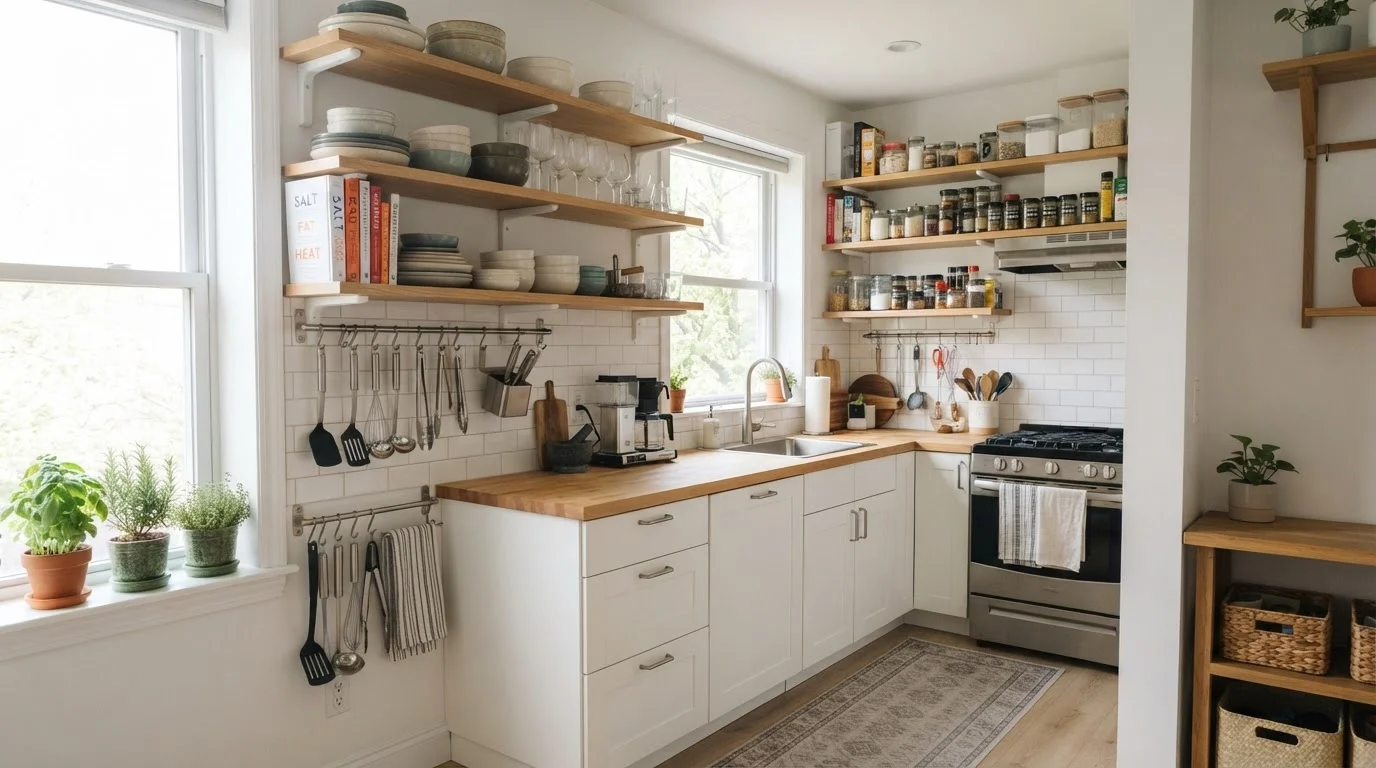
Most small kitchens have several feet of unused wall space between the counter and the upper cabinets, and again above those cabinets. A basic wall-mounted magnetic strip holds knives and metal tools, which removes a bulky block from the counter entirely. Simple pegboards or rail systems with hooks can hold ladles, measuring cups, and small colanders, keeping them accessible without occupying a single drawer.
Floating shelves above a window or beside a refrigerator work well for items used infrequently, such as a stand mixer or a large serving bowl. The cost of brackets and a plank of wood is usually far lower than a freestanding storage unit, and the footprint is zero.
Wall-mounted magnetic strips remove bulky knife blocks from the counter entirely.
Reorganize cabinet interiors with inexpensive inserts
Cabinet shelves are typically spaced for tall stacks, which wastes the middle layer of air. Wire shelf risers, available at most dollar stores and home goods retailers, turn one shelf into two half-levels. That change alone can double the visible storage in a pantry cabinet without touching a single wall.
Turntables (lazy Susans) placed inside corner cabinets make items at the back reachable without pulling everything out. Door-mounted racks use the inside face of cabinet doors for spice jars, foil rolls, or cleaning sprays, space that is otherwise wasted every time the door closes.
Wire shelf risers can effectively double usable shelf space at minimal cost.
Contain the pantry before it spreads to the counter
Loose bags, open boxes, and half-used containers tend to migrate onto counters because returning them to a disorganized pantry takes more effort than leaving them out. Uniform bins or baskets grouped by category (baking, snacks, grains) make it faster to put things away, so they actually get put away.
Decanting dry goods like rice, pasta, and oats into stackable canisters reduces the footprint those items take up by removing excess packaging. A well-organized pantry is one of the practical foundations behind the approach described in building a pantry full of staples, since you can actually see what you have and avoid duplicate purchases.
When returning items to the pantry is easy, they stop accumulating on the counter.
Divide drawers so every item has a fixed location
An undivided junk drawer expands to fill whatever space is available. Adjustable drawer dividers (bamboo, plastic, or even repurposed cardboard boxes) stop items from shifting and mixing. When utensils, batteries, rubber bands, and takeout menus each have a fixed zone, the drawer stays at capacity instead of overflowing into counter baskets.
For utensil drawers specifically, a two-layer insert with a shallow upper tray for everyday pieces and a lower compartment for less-used tools keeps a single drawer doing the work of two, without requiring a wider cabinet.
Adjustable drawer dividers stop a single junk drawer from spreading into counter space.
Declutter first, then decide what storage you actually need
Buying organizers before removing what is no longer needed is a common and costly mistake. A systematic room-by-room approach, like the one outlined in this room-by-room decluttering framework, can reveal that a kitchen already has adequate storage once duplicates, broken tools, and items used fewer than twice a year are removed.
Expired spices, novelty gadgets used once, and mismatched container lids are among the most common space-wasters. Removing them before purchasing a single bin or hook means the money spent on storage products goes toward genuine gaps rather than compensating for clutter. This is also consistent with the core idea behind a budget-friendly minimalist approach: owning less and storing it well costs less than owning everything and trying to find somewhere to put it.
Removing what you no longer use often reveals storage space that was already there.
Maximize the refrigerator sides and the space above it
The side of a refrigerator that faces open wall space accepts strong magnetic hooks and small magnetic bins that hold notepads, keys, or a box of plastic wrap, items that typically land on the counter by default. The top of a refrigerator, often ignored, can hold a flat-bottomed basket with rarely used appliances or a seasonal item like a large roasting pan.
This kind of secondary surface use costs nothing if items are simply relocated, or very little if a basket is added, and it tends to have an immediate visible effect on how much room the counter has to breathe.
Magnetic hooks and bins on refrigerator sides cost almost nothing and free counter space fast.
Putting it all together without overspending
Before buying any storage product
Measure the specific space you are trying to solve: shelf depth, drawer width, door clearance. Many low-cost organizers are returned because they do not fit the actual cabinet. A tape measure and five minutes of notes before purchasing saves money and a second trip. Generic sizing labels like 'standard' vary considerably between manufacturers.
These approaches work at different budget levels. Reorganizing drawers and relocating items to wall space costs nothing. Adding shelf risers, drawer dividers, or magnetic strips typically costs under $20 per area. Floating shelves or a full pantry bin system may cost more, but are still far less than built-in cabinetry.
The order matters: declutter first, measure second, buy only what fills a specific identified gap. Skipping the first two steps leads to organizers that don't fit or duplicate what you already own. A well-organized compact kitchen is achievable on a family budget when purchases are driven by actual measurement rather than general aspiration.