

Key Takeaways
Why financial literacy starts at home
Schools rarely teach kids how to compare prices, question a purchase, or decide when waiting is smarter than buying now. Those skills come from home, built through repetition and real decisions, not worksheets. Families that talk openly about money tend to raise children who treat it as a tool rather than a source of anxiety or excitement they can't manage.
Financial literacy for kids is not about turning a seven-year-old into a budgeter. It's about building the mental habit of asking: do I need this, can I afford it, and is there a better use for this money? Those questions, asked early and often, compound over time the same way interest does.
Families navigating tight budgets often worry that money conversations will stress their kids out. The opposite tends to be true. Children who understand why the family skips an impulse purchase or compares grocery prices are less likely to feel deprived and more likely to feel included in real decisions. See our guide to intentional spending for how to frame these conversations without turning them into stress.
Age-appropriate ways to introduce money concepts
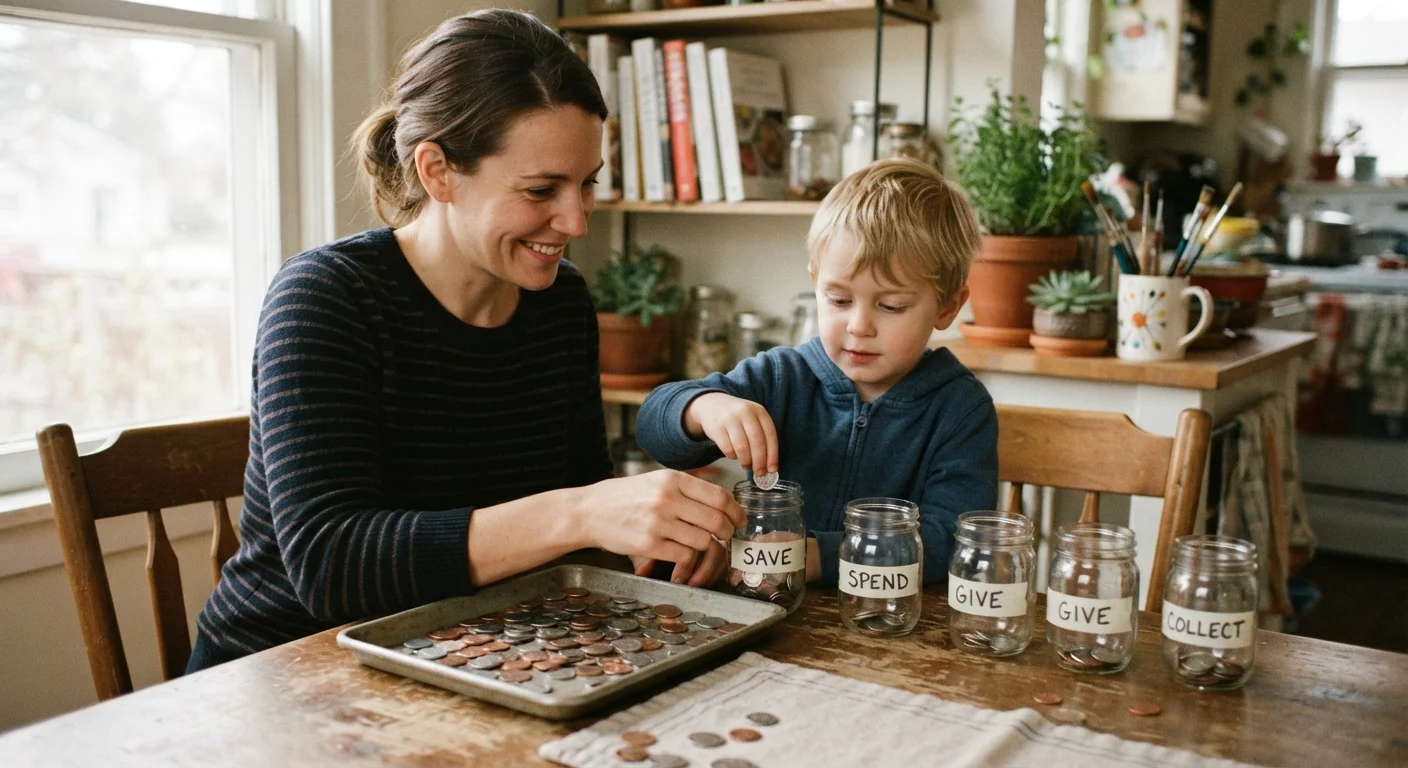
Children under six can handle concrete, physical money: coins they can sort, count, and put in jars. Abstract concepts like interest or debt mean nothing yet. At this stage, the goal is connecting money to exchange. Let them hand over cash at a store and wait for change.
Kids between six and ten are ready for simple budgeting. A three-jar system, one for spending, one for saving, and one for giving, works well because it makes abstract categories physical. When a child wants a toy that costs more than their spending jar holds, that gap becomes a real lesson in patience and trade-offs.
Preteens can handle more nuance. Introduce the concept of comparison: why does one box of cereal cost more than another? What's actually different? Grocery shopping together is one of the most practical classrooms available, and it's free. The healthy eating section of this site covers grocery strategies that families can walk through with kids in real time.
Teenagers are ready for bigger stakes. Consider giving them a fixed monthly amount that covers clothing or personal care, then stepping back. When the money runs short, the lesson lands without a lecture. This mirrors how adult budgets work far better than an open-ended allowance ever could.
Structuring allowance to teach real skills
Allowance without structure is just a handout. The most useful allowance systems connect money to decisions, not just chores. Chore-based allowances can work, but they sometimes create a transactional mindset where kids do the minimum required for pay rather than learning that some household contributions are just expected.
A more durable approach: give a base allowance tied to age (a rough starting point is one dollar per year of age per week, though families should adjust to what fits their budget), and require that a portion goes to saving before the child can spend anything. Even ten percent develops the habit of paying yourself first.
When kids want something beyond their allowance, treat it as an opportunity rather than a negotiation. Can they earn it by taking on an extra task? Can they wait until a birthday? The process of figuring that out is the lesson. Everyday habits that quietly undermine family financial goals explores how adult impulse patterns often start in childhood and go unexamined for years.
Bringing kids into household spending decisions
Children learn more from observation than instruction. When families make a spending decision, narrating it out loud, even briefly, turns an invisible adult process into a visible model. "We're buying the store-brand pasta because it tastes the same and saves us two dollars" is a complete financial literacy lesson.
Involve kids in planning a family activity on a fixed budget. Give them a number, explain what it covers, and let them help decide how to use it. Families that do this consistently find kids become more creative and less demanding about entertainment. The free and low-cost family entertainment guide has practical options families can plan around a real budget together.
Older kids can sit in on basic family budget reviews. Seeing real numbers, even simplified ones, makes the connection between income, spending, and savings concrete in a way no hypothetical exercise can match. It also reduces the likelihood of kids assuming the family has unlimited resources, a misconception that can create friction when requests get turned down.
Travel is another context where money lessons appear naturally. Comparing options, identifying hidden costs, and making trade-offs about what to spend on are skills kids can practice alongside adults. The guide on where families lose travel money without realizing it shows the kinds of patterns worth discussing with kids before a trip.
Building habits that outlast childhood
The goal of financial literacy at home is not perfect money management by age twelve. It's a set of reflexes: pause before buying, compare options, understand trade-offs, and save before spending. These reflexes form through repetition across hundreds of small moments, not through a single conversation or a one-time lesson.
Consistency matters more than comprehensiveness. A family that talks briefly about money a few times a week, through grocery runs, allowance decisions, and activity planning, will produce more financially capable adults than one that schedules a monthly "money talk" and otherwise leaves kids out of the picture.
The habits kids build around grooming, food, and daily routines also connect to financial patterns. Simple, consistent routines in any area of life reduce impulse decisions. The family grooming habits guide is one example of how routine-building in one area reinforces the same mindset across others.