

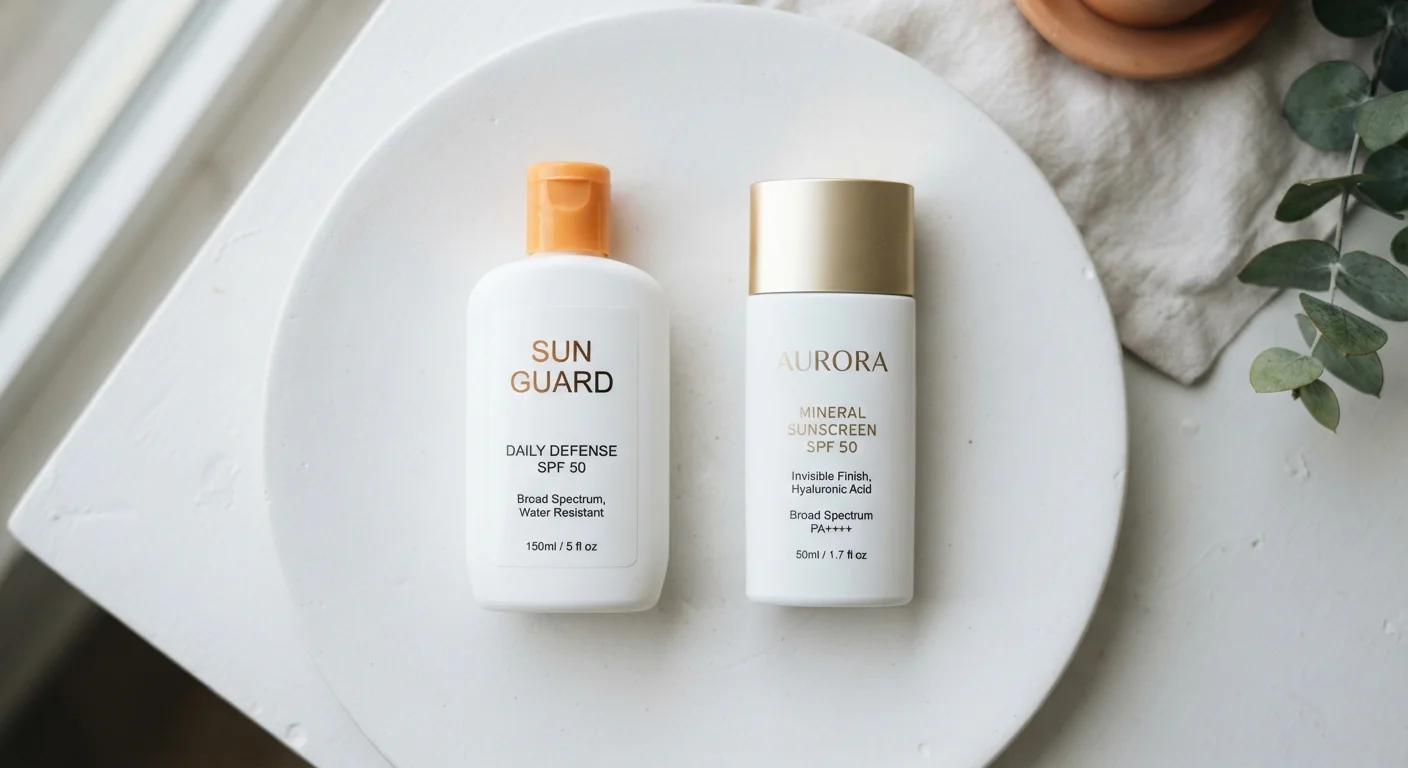
Key Takeaways
Option A
Drugstore sunscreen
The regulated, accessible everyday option.
Best for: Daily use when cost and availability matter more than texture or added skincare ingredients.
Option B
Department store SPF
The premium-formulated, cosmetically refined choice.
Best for: People who want sunscreen layered with serum-like ingredients or a finish that works under makeup.
If you want dependable daily UV protection on a tight budget
Drugstore sunscreen
FDA-regulated SPF and broad-spectrum standards apply equally, so you get the same core protection without the premium price.
If you want sunscreen that doubles as a tinted moisturizer or serum primer
Department store SPF
Luxury formulas frequently combine SPF with cosmetic actives like hyaluronic acid or light-diffusing pigments that most drugstore options do not include.
If you have sensitive or acne-prone skin
Drugstore sunscreen
Mineral-filter options with minimal added ingredients are widely available at drugstore prices and tend to have shorter ingredient lists, which can reduce irritation risk.
If texture and wear under makeup are your main concerns
Department store SPF
Premium brands invest in cosmetic elegance, producing lighter, less greasy finishes that are harder to find at lower price points.
What the SPF number actually measures
SPF stands for sun protection factor, and it measures a product's ability to block UVB rays, the wavelengths primarily responsible for sunburn and a known contributor to skin cancer risk. The number is a ratio: SPF 30 means it takes roughly 30 times as long for protected skin to burn as unprotected skin under the same conditions.
In practical terms, SPF 30 blocks about 97% of UVB rays. SPF 50 blocks about 98%. That one-percentage-point gap is real but narrow, and no sunscreen blocks 100%. The FDA requires that any product sold in the U.S. bearing an SPF number meet standardized testing protocols, whether it comes from a pharmacy shelf or a department store counter. The number means the same thing in both places.
What SPF does not tell you is anything about UVA protection. UVA rays penetrate deeper into skin and are associated with photoaging and longer-term damage. That is where the broad-spectrum label matters, and it is covered in the next section. For a closer look at how ingredient origins affect a product's overall safety profile, see the science behind natural vs. synthetic skincare ingredients.
Broad-spectrum claims and UVA protection
Since 2012, the FDA has required that any sunscreen labeled "broad spectrum" pass a standardized test confirming it protects against both UVB and UVA radiation in a specific ratio. A product that fails this test cannot use the claim, regardless of its price.
This rule applies uniformly. A $9 drugstore lotion and a $68 department store fluid must clear the same bar to print those two words on the label. Neither automatically protects better against UVA just because of its price.
Where formulas can differ is in which UV filters they use to achieve broad-spectrum coverage. Chemical filters like avobenzone, octinoxate, and oxybenzone absorb UV energy and convert it to heat. Mineral filters, zinc oxide and titanium dioxide, sit on the skin surface and physically scatter UV rays. Both approaches are available at drugstore and premium price points. The choice between them usually comes down to skin type, finish preference, and formula compatibility, not the retailer.
| Criterion | Drugstore sunscreen | Department store SPF |
|---|---|---|
| SPF regulation | FDA-standardized | FDA-standardized |
| Broad-spectrum requirement | Same FDA test | Same FDA test |
| UV filter types available | Chemical and mineral | Chemical and mineral |
| Added cosmetic ingredients | Minimal or none | Common (peptides, tints, etc.) |
| Texture and finish | Variable, sometimes heavy | Generally more refined |
| White cast risk (mineral) | More common | Less common, better milling |
| Typical price range | $8 to $20 | $40 to $90+ |
If understanding what each ingredient on a sunscreen label actually does is new territory, reading a beauty product label explains how to parse the active and inactive ingredient sections with confidence.
Where premium formulas actually differ
Department store sunscreens often cost more because they combine UV protection with cosmetic ingredients that drugstore versions rarely include. Formulations at the premium end may layer in hyaluronic acid for hydration, niacinamide to address uneven tone, peptides, or finely milled mineral pigments that give a tinted finish. These additions can make a product more convenient if you want a single step that covers multiple concerns.
Texture is another real difference. Cosmetic chemists working for luxury brands spend significant resources on the sensory profile of a formula, producing finishes that feel nearly weightless and leave no white cast. Achieving that finish in a $10 product is genuinely harder, though not impossible. Some drugstore mineral formulas still leave a noticeable white residue, which can be a practical barrier for people with medium to deep skin tones.
What premium pricing does not buy is a stronger SPF number or broader broad-spectrum coverage than the label states. The active ingredient doing the UV work is governed by the same regulations at every price point. For a wider view of which ingredients are worth paying more for versus which are not, skincare ingredients that punch above their price gives a useful breakdown.
Application quantity: the factor both products share
The SPF number on a label is only achieved when the product is applied at a specific density: 2 milligrams per square centimeter of skin. Most people apply far less than that in practice, which means the actual protection received is lower than the number suggests, regardless of whether the product cost $8 or $80.
For the face alone, a generous application is roughly a quarter teaspoon. For the full body, most guidelines point to about one ounce, equivalent to a full shot glass. Reapplication every two hours of sun exposure matters just as much as the initial layer. A $70 SPF 50 fluid applied too thinly provides less protection than a $12 SPF 30 lotion applied correctly and consistently.
The practical implication: if cost causes you to use a premium sunscreen sparingly, a less expensive product used at the right amount every day does more for your skin. That calculation is worth making before spending significantly more at the department store counter. To see how sunscreen fits into a cost-conscious routine overall, skincare spending you probably do not need covers where the budget is better directed.
This article is for general informational purposes only. It is not medical advice. Consult a qualified dermatologist or healthcare professional for personalized guidance on sun protection and skin health.