

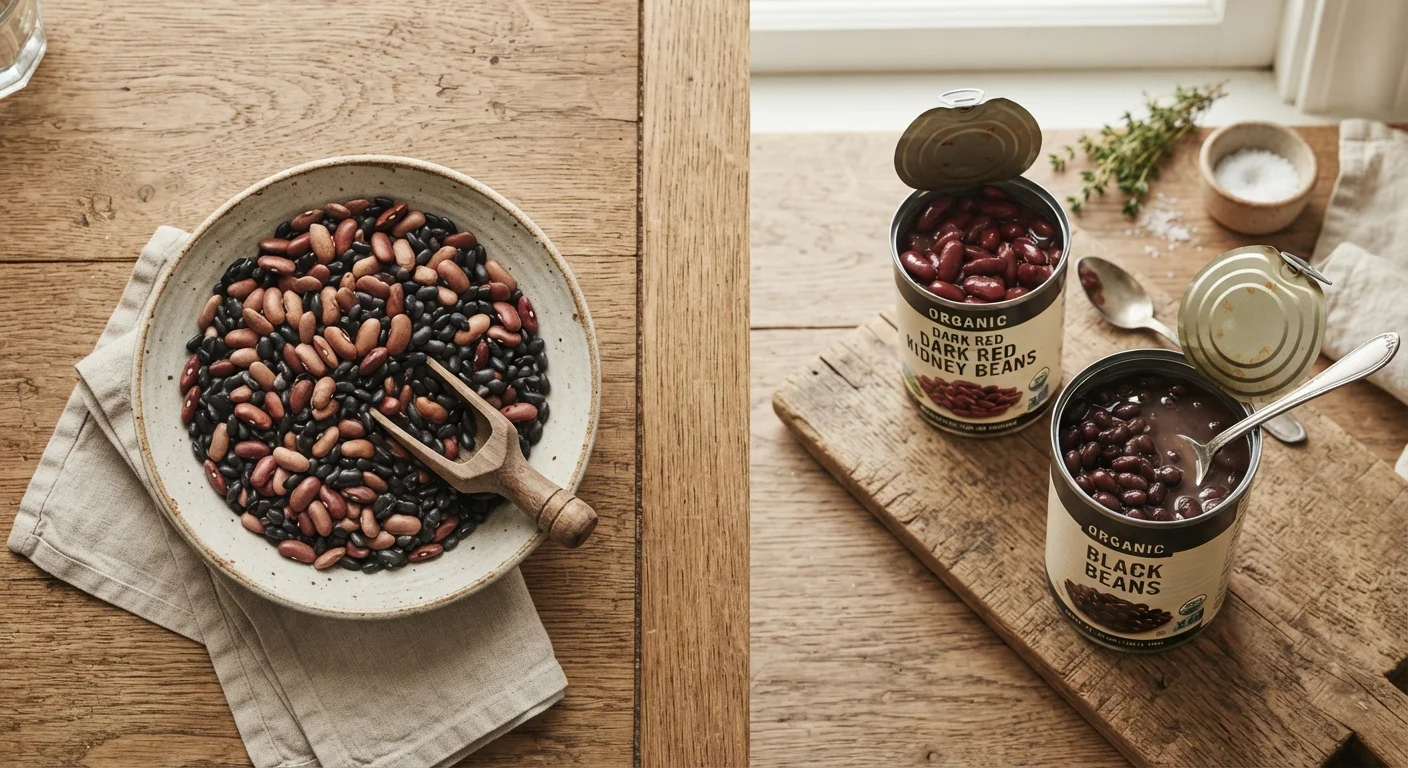
Key Takeaways
Option A
Canned beans
The ready-to-use, weeknight-friendly option.
Best for: Families who need protein on the table fast with no advance planning.
Option B
Dried beans
The lower-cost, lower-sodium option for planned meals.
Best for: Families with time to plan ahead and a goal of stretching the grocery budget as far as possible.
If your family needs dinner on the table in under 30 minutes
Canned beans
Canned beans require no soaking or long cooking. Drain, rinse, and they are ready to add to soups, tacos, or grain bowls immediately.
If you are working to lower your family's sodium intake
Dried beans
Dried beans cooked from scratch contain virtually no added sodium. This matters for households managing blood pressure or following a reduced-sodium diet.
If you batch cook on weekends and plan meals ahead
Dried beans
A single bag of dried beans can yield six or more cups of cooked beans at a fraction of the canned cost, portioned and frozen for the week.
If storage space or pantry organization is limited
Canned beans
Cans stack easily, have clear labels, and hold their quality for years with no special containers or monitoring needed.
If grocery budget is the top priority
Dried beans
Dried beans are generally the most affordable source of plant protein available, often costing three to four times less per serving than canned.
Cost per serving: where the gap is biggest
A 15-ounce can of beans yields roughly 1.5 cups of cooked beans, or about 3 servings. A one-pound bag of dried beans yields close to 6 cups cooked, or about 12 servings. When you compare unit prices at an average US grocery store, dried beans typically cost three to four times less per serving than canned. For a family eating beans twice a week, that difference adds up to real savings across a year.
Canned beans do carry a convenience premium, and that premium is not irrational. Time spent cooking has real value. Families weighing this choice should factor in how much cooking time they actually have, not just the sticker price. For a deeper look at how these decisions ripple through your weekly budget, see our meal planning vs. spontaneous grocery shopping comparison.
| Criterion | Canned beans | Dried beans |
|---|---|---|
| Average cost per serving | Higher (convenience premium) | Lower (3-4x less per serving) |
| Prep time | Under 5 minutes | 1-2 hours (or 25-40 min with pressure cooker) |
| Sodium per half-cup serving | 300-400 mg (before rinsing) | Under 5 mg |
| Protein per half-cup cooked | 7-8 grams | 7-8 grams |
| Fiber per half-cup cooked | 6-8 grams | 6-8 grams |
| Shelf life | 2-5 years unopened | 1-2 years in sealed container |
| Batch cooking suitability | Limited (fixed portion per can) | High (large yield per bag) |
Sodium and nutrition: the numbers behind each option
A half-cup serving of canned beans can contain 300 to 400 milligrams of sodium, depending on the brand and variety. The same portion from dried beans cooked in plain water contains under 5 milligrams. Rinsing canned beans under cold water for 30 seconds removes an estimated 40 percent of added sodium, which is a practical step for families watching salt intake. However, rinsing also washes away some water-soluble B vitamins that leach into the liquid during processing.
On other nutritional measures, the two forms are broadly equivalent. Both provide roughly 7 to 8 grams of protein and 6 to 8 grams of fiber per half-cup cooked serving, along with iron, folate, potassium, and magnesium. Beans are one of the most nutrient-dense foods per dollar available at any grocery store, whether canned or dried. For context on how they fit alongside other affordable whole foods, see our guide to pantry staples that reduce your weekly grocery bill.
~40%
Sodium removed by rinsing canned beans
Rinsing canned beans under running water for 30 seconds is a widely cited practical reduction strategy.
6+ cups
Cooked yield from one pound of dried beans
One pound of dried beans typically produces six or more cups cooked, equivalent to roughly four standard cans.
7-8g
Protein per half-cup serving (both forms)
Both canned and home-cooked dried beans deliver comparable protein, making either a reliable plant-based protein source.
This article is for informational purposes only and is not medical advice. Consult a qualified healthcare professional for guidance specific to your family's nutritional needs or health conditions.
Prep time and practical workarounds
The traditional method for dried beans calls for an overnight soak followed by 1 to 2 hours of simmering on the stovetop. That schedule rules them out for spontaneous weeknight meals. A quick-soak method shortens this: cover beans with water, bring to a boil for 2 minutes, then let them sit for one hour before draining and cooking. A pressure cooker or electric multi-cooker reduces cook time further, producing tender beans in 25 to 40 minutes with no pre-soaking required.
Batch cooking is the most efficient approach. Cooking a full pound of dried beans on a Sunday afternoon and freezing them in two-cup portions gives a family canned-bean convenience at dried-bean prices throughout the week. Label the bags with the date and bean variety, and they keep well in the freezer for up to three months. This approach pairs naturally with a planned grocery routine, which our meal planning comparison article covers in detail.
Which form works best in practice
Most families benefit from keeping both forms on hand. Canned beans belong in the pantry for nights when there is no time or energy for long cooking. Dried beans belong in the rotation when the weekend allows for batch prep. Using dried beans even once or twice a week produces measurable savings without adding meaningful stress to the cooking routine.
If sodium reduction is a priority, dried beans cooked from scratch are the more straightforward path. If a family already relies on a lot of packaged or processed foods, switching some of those items to home-cooked beans delivers nutritional gains alongside cost savings. Our article on the real costs of convenience foods breaks down where those trade-offs tend to be largest. Beans in either form also pair well with affordable vegetables; our look at vegetables with the most nutrition per dollar shows which ones stretch a meal budget furthest.