

Key Takeaways
Option A
Perennial plants
The long-term investment that returns year after year.
Best for: Gardeners who want a lower-maintenance, lower-cost foundation that fills in over multiple growing seasons.
Option B
Annual plants
The flexible, season-by-season color option.
Best for: Gardeners who want maximum color impact each season and enjoy changing their garden design year to year.
If you want to spend less money over time
Perennial plants
Perennials come back each season, so you buy once and divide them as they spread, cutting replacement costs significantly over several years.
If you rent your home or move frequently
Annual plants
Annuals let you invest minimally each season without leaving behind plants you paid for, and they work well in containers you can take with you.
If you want color from spring through fall with minimal gaps
Annual plants
Annuals bloom continuously for the entire growing season, so they fill beds and containers with color far longer than most perennials.
If you are building a new garden on a tight budget
Perennial plants
Starting with a perennial backbone means the garden grows in value each year without requiring a large annual spend to maintain the planting.
If you want to experiment with new plant varieties each year
Annual plants
Because annuals complete their life cycle in one season, you can try a completely different palette, layout, or plant type the following year.
What the terms actually mean
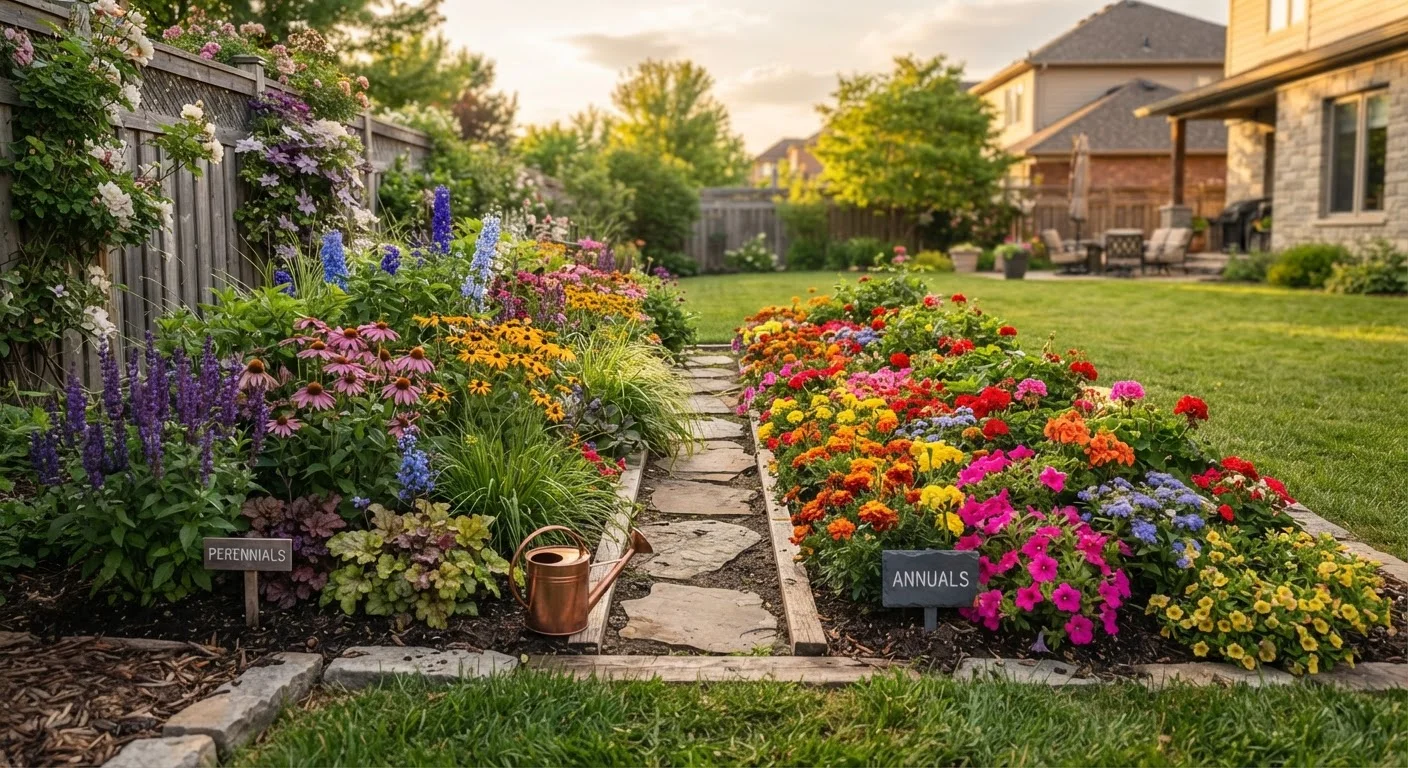
A perennial plant lives for more than two years. It grows, flowers, sets seed, and then goes dormant in winter before re-emerging the following spring. Common examples include coneflowers, hostas, daylilies, and black-eyed Susans. Over time, many perennials spread or can be divided, giving you more plants for free.
An annual plant completes its entire life cycle, germination through seed production, in a single growing season. It then dies. Marigolds, zinnias, petunias, and impatiens are familiar examples. Some plants sold as annuals in colder climates are technically perennials in their native tropical regions, but they cannot survive a US frost and are treated as annuals in most of the country.
A third category worth knowing is biennials: plants that take two years to complete their cycle, flowering only in the second year. Foxglove and hollyhock are common examples. Biennials are less common in garden centers but worth understanding if you grow from seed. For the purpose of planning a family garden, the perennial versus annual decision covers the majority of what you will encounter.
Cost and long-term value
Perennials cost more at the nursery, often two to four times the price of a comparable annual transplant. That gap narrows quickly when you account for the fact that a healthy perennial returns each year and many can be divided every three to four years to multiply your stock. A single coneflower clump bought for $8 can become three or four plants within a few seasons at no extra cost.
Annuals require a fresh purchase every spring. Seed packets are far cheaper than transplants, and growing annuals from seed is one of the most effective ways to keep garden spending low. A $3 packet of zinnia seeds can fill a large bed that would cost $30 or more in nursery transplants. If budget is tight, buying a small number of perennial anchors and filling gaps with self-sown annuals each year is a practical middle path.
| Criterion | Perennial plants | Annual plants |
|---|---|---|
| Lifespan | 3 or more years | One growing season |
| Upfront cost | Higher per plant | Lower per plant |
| Ongoing cost | Low once established | Replant cost each season |
| Bloom duration | 2 to 6 weeks per season | Full season until frost |
| Time to establish | 1 to 2 seasons | Immediate same season |
| Design flexibility | Fixed layout long-term | Change design each year |
| Propagation potential | Many can be divided free | Save seed each fall |
For a deeper look at how your planting approach affects long-term costs, see our guide on raised bed versus in-ground gardening, which covers soil investment and setup trade-offs in similar detail.
Maintenance and time commitment
Perennials demand less routine work once established, but the establishment phase, typically the first one to two seasons, can require consistent watering and some attention to weed competition. After that, most perennials are largely self-sufficient. Deadheading prolongs blooming for some varieties, and a cut-back in late fall or early spring keeps beds tidy, but neither task is time-intensive.
Annuals need replanting every season, which is the primary labor cost. In exchange, they give you continuous bloom from planting to frost, something few perennials match. If you grow annuals from seed indoors, add six to eight weeks of seed-starting time before the last frost date to your schedule. That said, direct-sow annuals like sunflowers and nasturtiums go straight into the ground with almost no extra effort.
If you are new to reading seed packets and want to understand germination timelines and spacing requirements, our seed packet field guide explains the numbers you will encounter on the back of the packet.
Seasonal performance and design flexibility
Most perennials bloom for two to six weeks per season. That means a garden planted only with perennials can look sparse or dull for stretches of the summer if you have not planned for overlapping bloom times. Pairing early-blooming perennials like lupines with mid-season varieties like coneflowers and late bloomers like sedums spreads color across the growing season.
Annuals solve the bloom-gap problem directly. Plants like marigolds, petunias, and impatiens flower from planting through the first frost. Their steady color output makes them useful for containers and high-visibility spots like front walkways. If you garden in containers, annuals generally outperform perennials in pots because they bloom longer and do not need the root space perennials develop over time. Our guide to container gardening on a budget covers which plant types perform best in small spaces.
Design flexibility favors annuals. Because you replant them each season, you can change colors, textures, and arrangements from one year to the next. Perennials lock in your layout more permanently, so it pays to research mature plant size and spread before planting.